

I started working from the couch two years ago, not because it looked cozy in some influencer's home office tour, but because a meniscus repair on my left knee made sitting in a regular desk chair for six hours a miserable idea. My part time work, invoicing and email for a small property management company, had to happen wherever I could prop that leg up, and for the first eight months that meant a laptop balanced on a couch cushion, sliding an inch to the left every time I shifted my weight.
I went through three cheap folding lap trays before I landed on the one I'm actually reviewing here, the SAIJI Laptop Bed Desk Table. I want to be upfront about something most reviews skip over. I did not love this thing the day it arrived. It took about three weeks of actual use before I understood what it was genuinely good at and what it wasn't, and that gap between the marketing photos and the daily reality is exactly what I want to walk you through.
The Quick Verdict
A solid, adjustable lap desk that fixes the sliding-laptop problem for good, but the drawer and the heat buildup keep it from being the flawless couch office nobody warns you about.
Amazon Check Today's Price →Tired of catching your laptop before it slides off your knees?
The SAIJI lap desk locks your laptop in place with raised edges and an adjustable tilt, so you're not spending half your work session just holding it steady. See today's price on Amazon and decide if it solves your setup.
Amazon Check Today's Price on Amazon →What a Year of Actual Use Looks Like
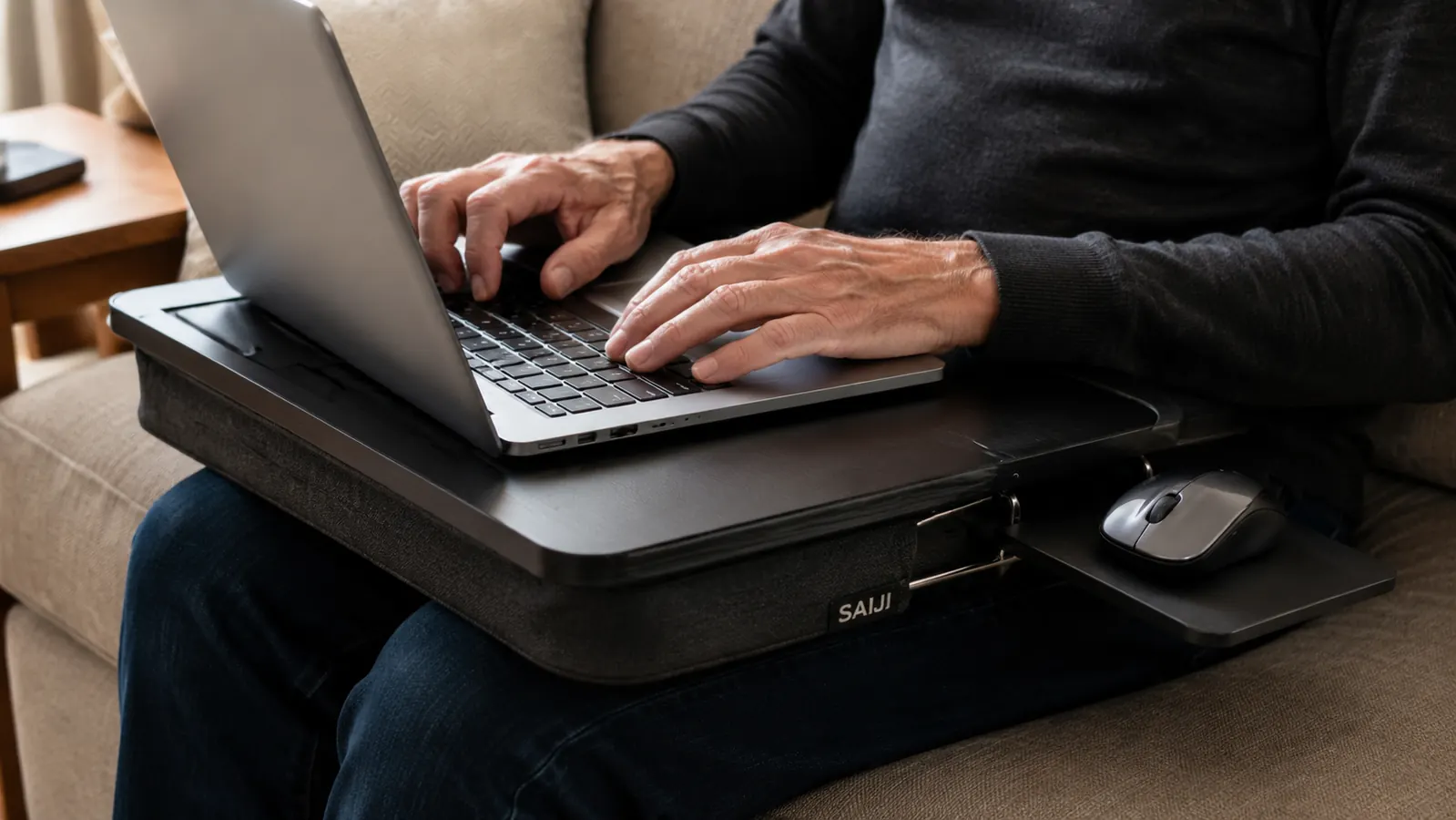
Here's what my mornings actually look like now. I sit on the same corner of the couch I always did, prop my bad knee up on a pillow, and set the SAIJI desk across my lap with the legs folded flat against the underside, more like a tray than a stand. When I need it angled up for typing instead of flat for reading, I flip out the two side legs and lock them into one of the notches. There are six angle settings total, and the whole board tilts from almost flat to close to a 30 degree slope.
The board itself is about 23 inches wide and just over 15 inches deep, enough room for a 17 inch laptop with a couple inches to spare on either side, plus a narrow mousepad shelf built into the right edge that folds down separately from the main surface. That mouse shelf was actually the detail that sold me on this one over the two cheaper trays I'd already returned. Neither of those had anywhere for a mouse, so I'd been using the couch cushion itself as a mousepad, which worked about as well as you'd expect.
Assembly took about ten minutes out of the box, four screws to attach the legs and the mouse shelf, with a hex key included in the box. That's another small thing that separated it from the bamboo tray I'd tried first, which arrived fully assembled but also arrived with one leg already a little wobbly from a cheap glue joint. I'd rather spend ten minutes with a hex key than deal with a wobble I can't fix.
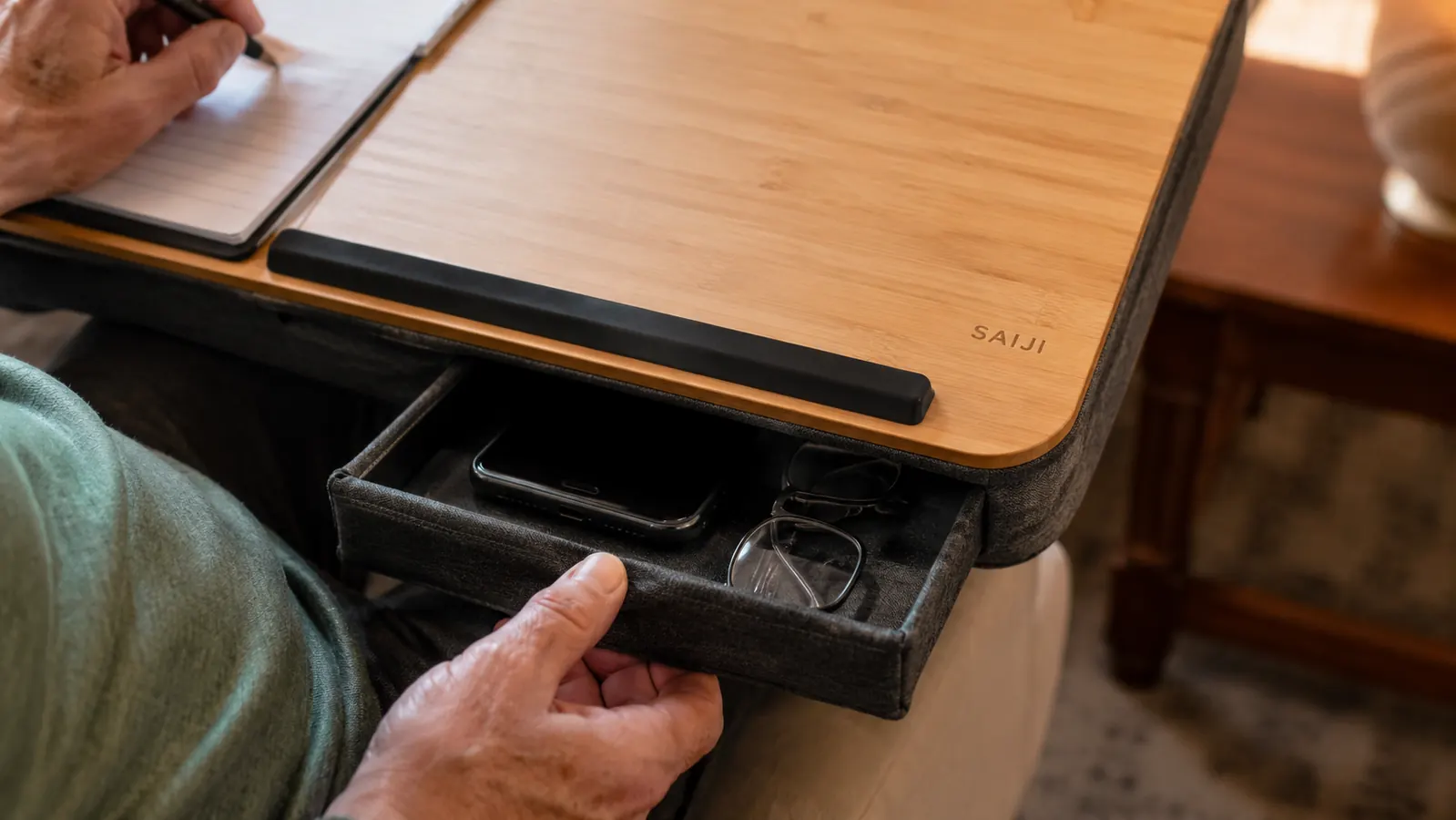
There's also a drawer built into the front edge, shallow, maybe an inch and a half deep, that's supposed to hold a phone, glasses, a notepad, that kind of thing. I'll get into what nobody tells you about that drawer in a minute, because it's not quite the convenience the product photos make it look like.
The whole thing weighs about seven pounds, which sounds light until you're carrying it from the living room to the bedroom every night, which I did for the first two months before I gave up and just left it propped against the wall between the couch and the side table. It folds flat enough to slide under a bed frame with a few inches of clearance, but I'll be honest, after the novelty wore off, moving it between rooms became one more thing I didn't do consistently. If you're buying this thinking you'll carry it from a home office to the living room and back every day, ask yourself honestly whether you'll actually keep that up after the first few weeks.
What Made Me Choose This Over the Two I Returned
Before this one, I bought a bamboo folding tray from a big box store and a thin aluminum one that looked sleek in the photos but weighed almost nothing, which turned out to be part of the problem. The bamboo tray had no cushioning on the underside at all, just hard wood resting directly on my thighs, and after twenty minutes my legs would go numb in a way that made me stop working just to shift position. The aluminum one was so light it slid around on any surface that wasn't perfectly flat, cushion or not.
The SAIJI desk has a padded cushion on the underside, foam wrapped in fabric that grips the couch instead of sliding against it, and that one change fixed both problems at once. My legs stopped going numb, and the board stopped migrating an inch every few minutes the way the aluminum one did. It's also just heavy enough, at around seven pounds, that it doesn't feel like it will tip if I lean to one side to reach for my coffee.
None of this means it's the only option worth considering. If you mostly work at a real desk and just want an occasional lap surface for the couch on weekends, a lighter tray might suit you fine. But if you're doing what I do, real work hours most days, from the couch or bed, the extra weight and the padded underside are the two things that made the difference between a tray I tolerated and one I actually reach for every morning.
The Drawer Isn't What the Photos Make It Look Like
The drawer sits right below the mouse shelf, and in the listing photos it looks like a tidy little cubby for your phone and a pen. In real life, once you tilt the board up past the third notch, gravity takes over and anything heavier than a phone starts sliding toward the front edge. My reading glasses did this twice in the first month, sliding right out onto the floor while I was mid sentence in an email, and the second time one of the arms bent slightly when it hit the hardwood.
I've since learned to only use the drawer when the board is flat or on the first two angle settings, which is fine for me since I mostly use it for holding my phone during calls, but if you're picturing sliding your glasses, a snack, and your phone all into that drawer while you work at a steeper angle, you'll be disappointed. It's a nice extra when the board is low. It's basically decorative once you tilt it up for real typing.
The Heat and Balance Nobody Warns You About
This is the part that surprised me most, because it's not something any of the five star reviews I read before buying ever brought up. After about 45 minutes of continuous use, especially in shorts or leggings, the underside of the board where the laptop sits gets noticeably warm against your legs. It's not dangerous, but it's the kind of thing where you start shifting positions every so often just to give your skin a break, especially if your laptop already runs warm the way mine does with three browser tabs and a spreadsheet open.
The other thing is balance, and this depends entirely on what you're sitting on. On a firm couch cushion or a dining chair, the four folding legs sit flat and the whole thing feels sturdy, barely any wobble even when I'm typing hard. On my sectional's softer cushions, though, the legs sink in unevenly, and I've had the board tip slightly to one side more than once, enough that I now automatically reach out and steady it with my forearm before I start typing, almost without thinking about it anymore. Nobody mentions that a lap desk's stability depends as much on your couch as it does on the desk.
Nobody in the reviews mentioned that a lap desk's stability depends as much on your couch as it does on the desk itself.
How the SAIJI Actually Held Up Over a Year
A year in, the biggest visible change is on the top surface. Mine came in the dark black finish, and it shows scuff marks more than I expected, mostly from where my laptop's rubber feet have rubbed the same four spots over and over. They're not deep scratches, more like faint gray marks you can see at an angle in bright light, but if you're particular about things looking new, know that a matte black surface used daily for a year is not going to look showroom fresh.
The folding legs and the angle adjusting hinge still work the way they did on day one, no wobble in the mechanism itself, though one of the two side legs has developed a faint squeak when I fold it flat that a drop of household oil fixed in about ten seconds. I kept waiting for the mouse shelf hinge to loosen the way cheaper trays did within a few months, and so far it hasn't, which is honestly the main reason I'd buy this SAIJI desk again.
Cleaning is simple. A damp cloth handles crumbs and coffee rings fine, and the drawer pulls all the way out for a proper wipe down every couple of months. I wouldn't call any of this a design flaw. It's just what a piece of furniture looks like after real use instead of a week sitting on a shelf.
What I Liked
- Six angle settings actually change how you use it, from reading flat to typing at an incline
- Built-in mouse shelf means you're not using your couch cushion as a mousepad
- Sturdy on firm surfaces with no wobble in the folding mechanism after a year of daily use
- Fits a 17 inch laptop with room to spare on either side
- Wipes clean easily and the drawer removes for a deeper clean every couple of months
Where It Falls Short
- Drawer only stays useful when the board is flat or on a low angle setting
- Underside gets warm against bare legs after 45 minutes or so of continuous use
- Tips slightly on soft couch cushions, much less so on firm seating
- Dark black finish shows scuff marks from laptop feet within a few months
- One side leg developed a minor squeak that needed a drop of household oil
Still balancing your laptop on a couch cushion?
A year of real use taught me where the SAIJI lap desk earns its keep and where it doesn't, but it's still the sturdiest, most adjustable option I found after going through two cheaper trays first. Check today's price on Amazon and see if it fits how you actually work.
Amazon Check Today's Price on Amazon →
Who This Is For
This is for anyone who spends real hours, not just a quick email check, working from a couch or bed and is tired of chasing a sliding laptop across their knees. If you want somewhere for your mouse that isn't the cushion next to you, and you're working from a firmer piece of furniture like a recliner, a dining chair, or a couch with decent cushion support, this solves the actual problem well. It's also a good fit if you're recovering from a joint surgery like I was, or if you just prefer working reclined some days and upright at a desk on others, since it folds flat enough to store leaning against a wall or slide under a bed.
I'd also point this at anyone who's tried a cheap folding tray before and given up on the whole idea because it felt flimsy or uncomfortable. That was me for the better part of a year. The difference between a bargain aluminum tray and this one isn't cosmetic, it's the padding and the weight, and if your last attempt at a lap desk ended up in the closet, this is worth trying once more before you write off the whole category.
Who Should Skip It
If your main seating is a very soft, overstuffed couch, expect some tipping until you get used to bracing it, and factor that into your decision before you buy. If you plan to use the drawer for anything besides a phone at a low angle, you'll want a different accessory, maybe a small caddy that sits beside you instead. And if you run hot easily or wear shorts most of the day, be ready to shift position periodically rather than expecting to sit still under it for a three hour stretch. None of these were dealbreakers for me, but they would have changed my expectations going in if I'd known them ahead of time.
And if portability between rooms is the whole point for you, temper your expectations a little. Seven pounds isn't heavy exactly, but it's enough that carrying it from room to room every single day gets old fast, and in my experience most people, myself included, end up picking one spot for it and leaving it there.
Ready to stop chasing a sliding laptop?
After a year of daily use, warts and all, the SAIJI lap desk is still the one I reach for every morning. Check today's price on Amazon before you settle for another cheap folding tray.
Amazon Check Today's Price on Amazon →