

Four months ago I gave up on the kitchen table. My chair there was doing something unkind to my lower back after about ninety minutes, and the table itself was six inches too high for typing comfortably. I moved to the couch instead, which felt like a small defeat at first, like admitting I couldn't set up a real home office. What actually happened is that the couch turned out fine. The problem was never the couch. The problem was that I had nothing to put the laptop on besides my own legs, and after about twenty minutes my knees would start to ache from the heat and the weight.
That's what sent me looking for a lap desk in the first place, and after reading through more reviews than I'd like to admit, I settled on the SAIJI adjustable lap desk with the storage drawer. It runs under seventy dollars, it's rated to fit a 17 inch laptop, and it had enough reviews (over ten thousand at the time I checked) that I felt reasonably confident I wasn't buying a dud. Four months of near-daily use later, I have a much clearer picture of where it earns its keep and where it falls short, and I'd rather tell you both than just the good parts.
The Quick Verdict
A sturdy, genuinely adjustable lap desk that solved the heat and knee-pressure problem within the first week. The storage drawer is more useful than I expected, and the tilt hinge held up fine after four months of daily folding. My only real complaints are the drawer's small size and a slightly wobbly feel on soft couch cushions.
Amazon Check Today's Price →Tired of your laptop cooking your knees by lunchtime? This is the fix that actually stuck.
The SAIJI lap desk gave my legs somewhere to breathe and gave my laptop a stable, slightly tilted surface instead of a moving cushion. Four months in, it's still the first thing I reach for when I sit down on the couch to work.
Amazon Check Today's Price on Amazon →How I've Used It
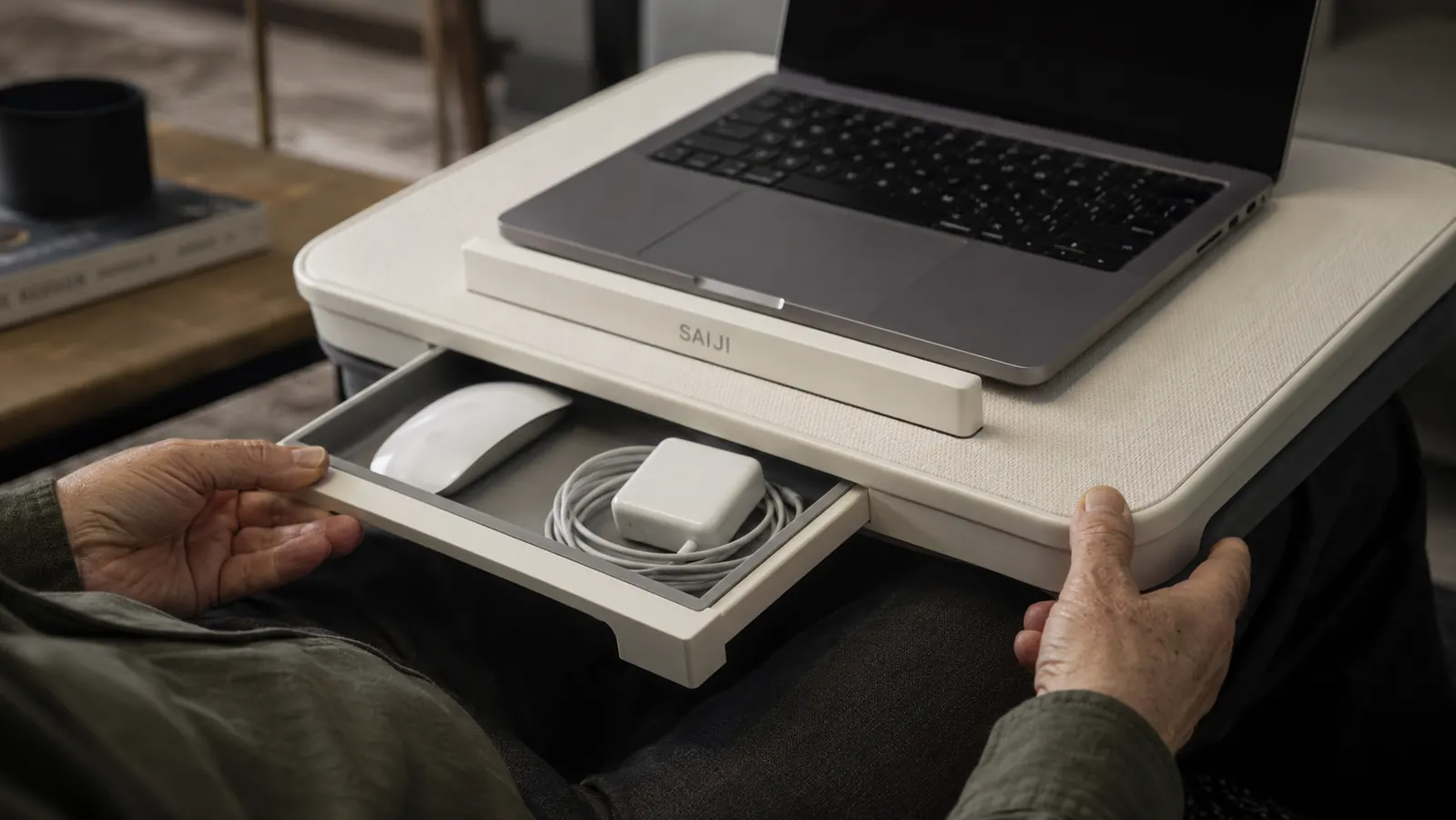
My setup is simple. I work from the couch three or four mornings a week, usually for two to three hour stretches, with a 15 inch laptop and sometimes a small external mouse. The SAIJI lap desk has a wood-look top with raised edges on one side (I use that side for pens, my phone, and the odd sticky note) and it folds out into two side legs that let you adjust the height and the tilt angle independently. Underneath the main surface there's a shallow drawer, and below that, mesh cooling vents that are supposed to let heat from the laptop escape instead of building up against your legs.
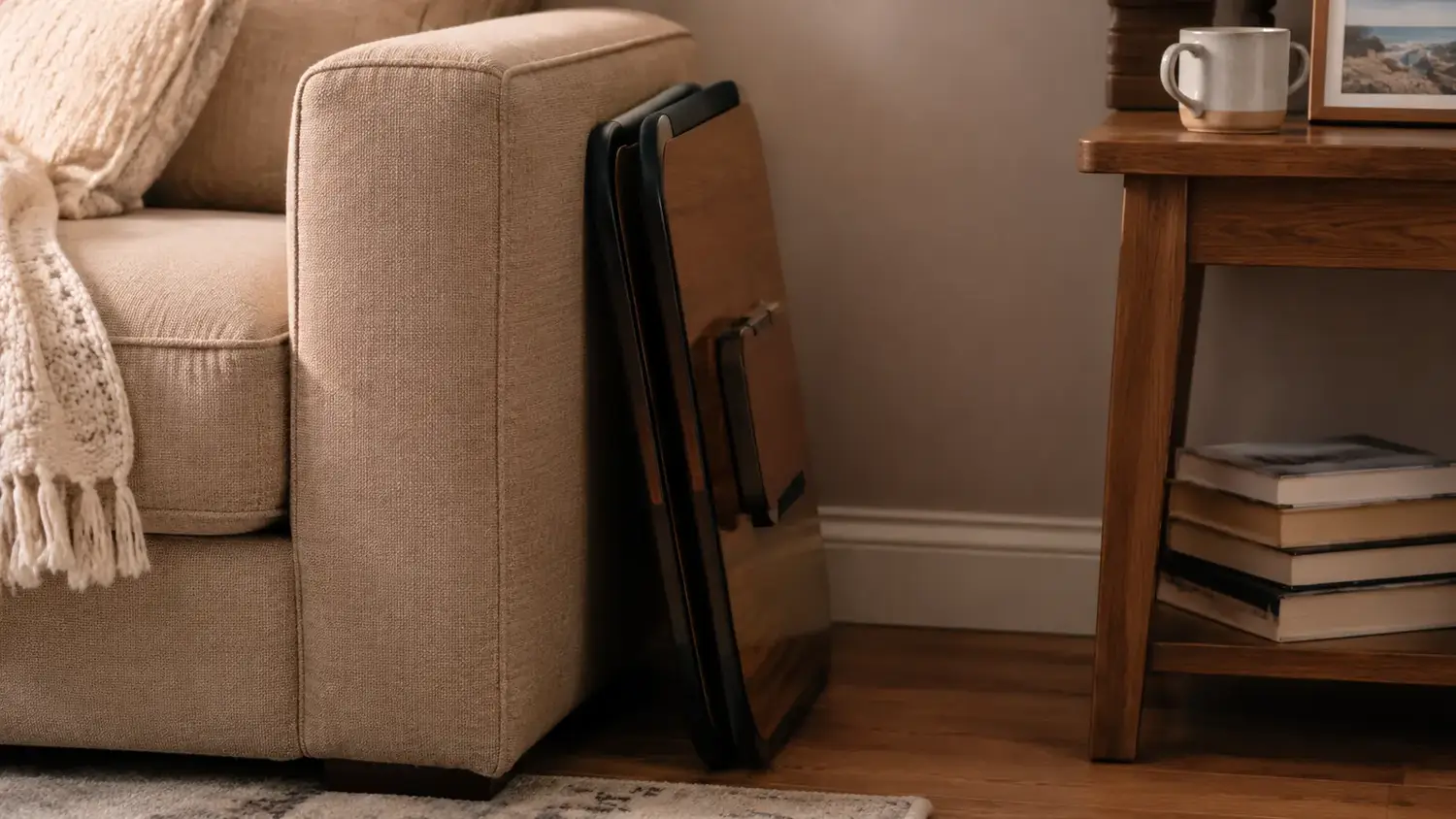
I've used it sitting cross-legged, sitting with my feet flat on the floor and knees bent at ninety degrees, and reclined with my legs stretched out on the ottoman. It adjusts to all three positions without much fuss. The legs fold flat against the underside of the desk when I'm done, and the whole thing leans against the arm of the couch or slides under it when I'm not using it, which matters more than I expected. I don't have a spare room for a desk. This thing needing to disappear when it's not in use was a real requirement, not a nice-to-have.
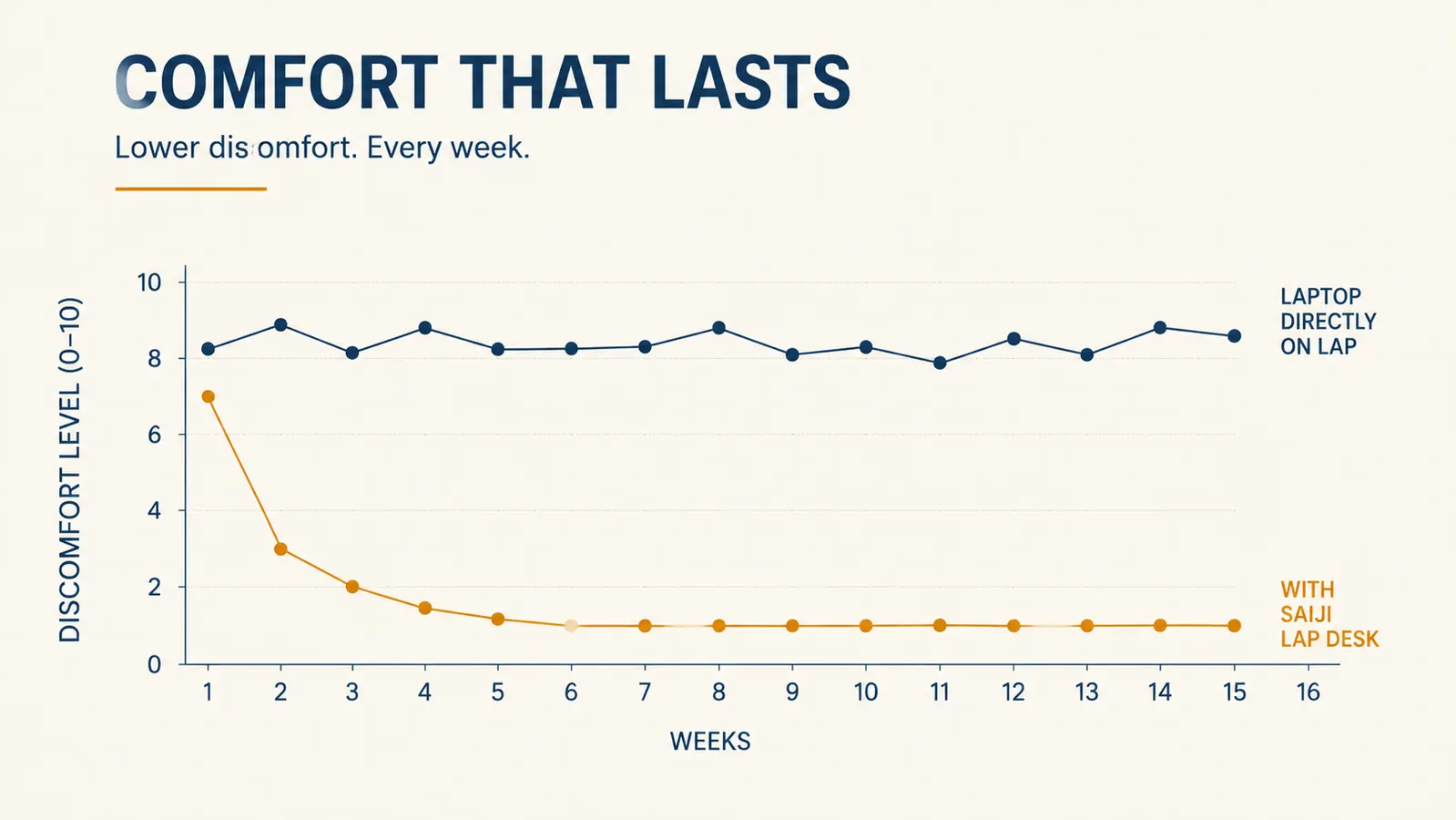
The cooling vents are the detail that convinced me this wasn't just a fancy tray. My laptop runs warm when I have several tabs and a video call open at once, and on my old setup, directly on my lap, that heat had nowhere to go. With the SAIJI lap desk between the laptop and my legs, that heat mostly just isn't a problem anymore. I still notice warmth on the surface after a long call, but it's nothing like what I felt through a pair of jeans before.
Assembly and First Impressions
The SAIJI lap desk arrived already mostly assembled, which mattered to me because I'm not the person in the house who enjoys reading instruction sheets. The two side legs were pre-attached to hinges on the underside of the main board, and setting it up the first time meant unfolding the legs, locking them into one of several notched height positions, and adjusting the tilt lever near the top edge. It took under two minutes, and I didn't need a screwdriver or any tool at all. That first-use ease mattered more than I expected, because a lap desk that requires real assembly work every single time you sit down defeats the purpose of something meant to be quick and casual.
The material feels like a dense engineered wood board with a laminate finish rather than solid wood, which is honestly the right call at this price and this weight. It's light enough to carry one-handed from the closet to the couch, roughly the heft of a large cutting board, but it doesn't feel hollow or cheap when you tap on the surface. The edges are rounded and smooth, no sharp corners digging into my forearms during long typing sessions, and the raised lip on one side has stopped my phone from sliding off more than once when I shifted position on the cushion.
My first week was mostly spent figuring out which height notch and tilt angle actually worked for my particular couch and my particular posture, and that trial period is worth planning for. It's not an instant, one-size-fits-all fit. Once I landed on a combination, roughly a mid-height setting with a slight forward tilt, I stopped adjusting it at all and it's stayed at that setting for the better part of four months.
The Storage Drawer, Four Months Later
I was skeptical about the drawer when I first unboxed the SAIJI lap desk. It looked like the kind of feature that sounds good on the product page and then never actually gets used, the way half my kitchen gadgets do. It's held a small wireless mouse, a phone charging cable, a pack of gum, and a notepad since roughly week two, and I open it several times a day without thinking about it. It's not deep enough for a laptop charger brick, which is a real limitation if that's what you were hoping to hide away, but for small accessories it's earned its spot.
The drawer slides on a simple track, no ball bearings or soft-close mechanism, so it's a little sticky if you're not pulling it straight out. After four months of daily use it hasn't come off the track or cracked, which is more than I expected for a drawer built into a desk this price. If you're picturing it as real storage for cables and a full mouse-and-keyboard combo, scale that expectation down. It's a glasses-case-sized drawer, not a filing cabinet.
Stability on a Soft Couch
This is where I have to be honest, because most reviews gloss over it. On a firm cushion or a dining chair, the SAIJI lap desk sits rock solid. On my couch, which has cushions on the softer side, the legs sink slightly and the whole thing has a small amount of give when I lean into it or type aggressively. It's never dumped my laptop or felt unsafe, but if you press down hard on one corner you can feel the legs shift a bit into the cushion. On a firmer surface, like an armchair with less padding or a bed with a supportive mattress, that wobble mostly disappears.
I've adjusted for this by keeping the legs at a slightly wider stance and sitting more centered under the desk rather than off to one side. It's a minor habit change, and once I made it, the wobble stopped being something I noticed. But I'd rather tell you it's there than let you find out for yourself on day one and think something's wrong with the desk. It isn't broken. It's just interacting with a soft cushion the way any four-legged tray would.
I tested it on four different surfaces over the four months, my living room couch, a firmer guest room bed, a recliner with thin padding, and a folding camp chair I keep for the porch. The recliner and the camp chair were the most stable by far, since both have less cushion give than a couch. The guest room bed landed somewhere in the middle. If stability is your top priority and you mostly work from a very plush couch, it's worth testing your own furniture in the first week, since return windows exist for exactly this reason, and adjusting where you sit on the cushion makes a real difference.
Who Else I Tested This With
My husband uses it on weekends to answer emails from the recliner, and my daughter borrowed it for two weeks in the spring when she was working from our house between apartments. Both of them landed in roughly the same place I did: genuinely useful, occasional wobble on soft furniture, drawer smaller than they expected but still handy. Neither of them wanted to give it back, which is its own kind of review. My daughter ended up buying her own SAIJI lap desk instead of taking mine when she moved, which told me more than any star rating could.
What struck me watching both of them use it is how differently each person adjusted the tilt. My husband keeps his nearly flat, since he mostly types long emails and doesn't like any angle. My daughter tilted hers up noticeably higher, closer to a drafting-table angle, because she was doing a lot of reading on screen and said the angle reduced neck strain during long stretches. That range of adjustment is one of the quieter strengths of the SAIJI lap desk. It isn't locked into one posture the way a flat board or a fixed-angle stand would be.
Comparing It to a Flat Board
Before the SAIJI lap desk, I actually tried a flat wooden cutting board propped on a couple of throw pillows for about a week, mostly out of stubbornness about not wanting to spend money on something that sounded like a gimmick. It solved the direct-heat problem but nothing else. There was no tilt, no drawer, no stable height, and pillows shift the second you move your legs. The SAIJI lap desk's adjustable legs and locked hinge angle are the actual reason I stopped noticing my posture at the end of a work session. A flat board is better than nothing. It is not close to the same experience as a lap desk built for this specific job.
The cost difference didn't turn out to matter as much as I expected going in. A decent cutting board and a couple of firm pillows cost roughly the same as a mid-range lap desk once you account for how often pillows lose their shape and need replacing. What you're really paying for with something like the SAIJI lap desk is the adjustability and the fact that it holds its shape and angle indefinitely, where pillows compress and go soft within weeks. Four months later, my makeshift board-and-pillow setup is long gone, and the lap desk is still doing exactly what it did on day one.
What I Liked
- Cooling vents genuinely reduce heat against your legs during long sessions
- Adjustable tilt and height work well across couch, chair, and bed positions
- Storage drawer holds small accessories and gets used daily, not just at unboxing
- Folds flat and stores easily against furniture when not in use
- Sturdy enough on firm surfaces to type hard without noticing any flex
- Arrives nearly assembled, no tools needed to set up the first time
Where It Falls Short
- Noticeable wobble on soft couch cushions unless you center your weight
- Drawer is too shallow for a laptop charger brick or anything bulky
- Wood-look top shows fingerprints and needs a quick wipe most days
- No cushion or padding underneath, so it rests directly on your legs or lap
It didn't fix my posture. It fixed the one thing that was actually making the couch uncomfortable, which was heat and pressure on my knees, not the couch itself.
Who This Is For
If you're working from a couch, bed, recliner, or any spot without a proper desk, and your laptop's heat or weight is the thing making it uncomfortable after twenty or thirty minutes, the SAIJI lap desk solves that specific problem well. It's also a good fit if you don't have room for a second workstation and need something that folds away completely between sessions. Retirees picking up freelance or remote work later in life, people recovering from surgery who need to work reclined, and anyone splitting their day between a home office chair and a softer spot in the afternoon will likely get real, daily use out of it the way I have.
Who Should Skip It
If most of your work happens at a proper desk and you'd only use this occasionally, a lap desk is probably overkill, and the money would go further toward something you'd use every single day. If you need serious cable and accessory storage built into the surface itself, the SAIJI drawer will disappoint you, it's genuinely small. And if you mostly sit on very soft, deep cushions and can't adjust your seating position to reduce wobble, you may find the stability less than ideal, though it's still workable for most people once you get used to it.
Still balancing a hot laptop on your knees? Four months in, I still reach for this every day.
The SAIJI lap desk has held up through daily use on my couch, my recliner, and my daughter's bed, without a single hinge or leg failing. If your current setup is just a laptop directly on your lap, this is the upgrade that actually gets used.
Amazon Check Today's Price on Amazon →