
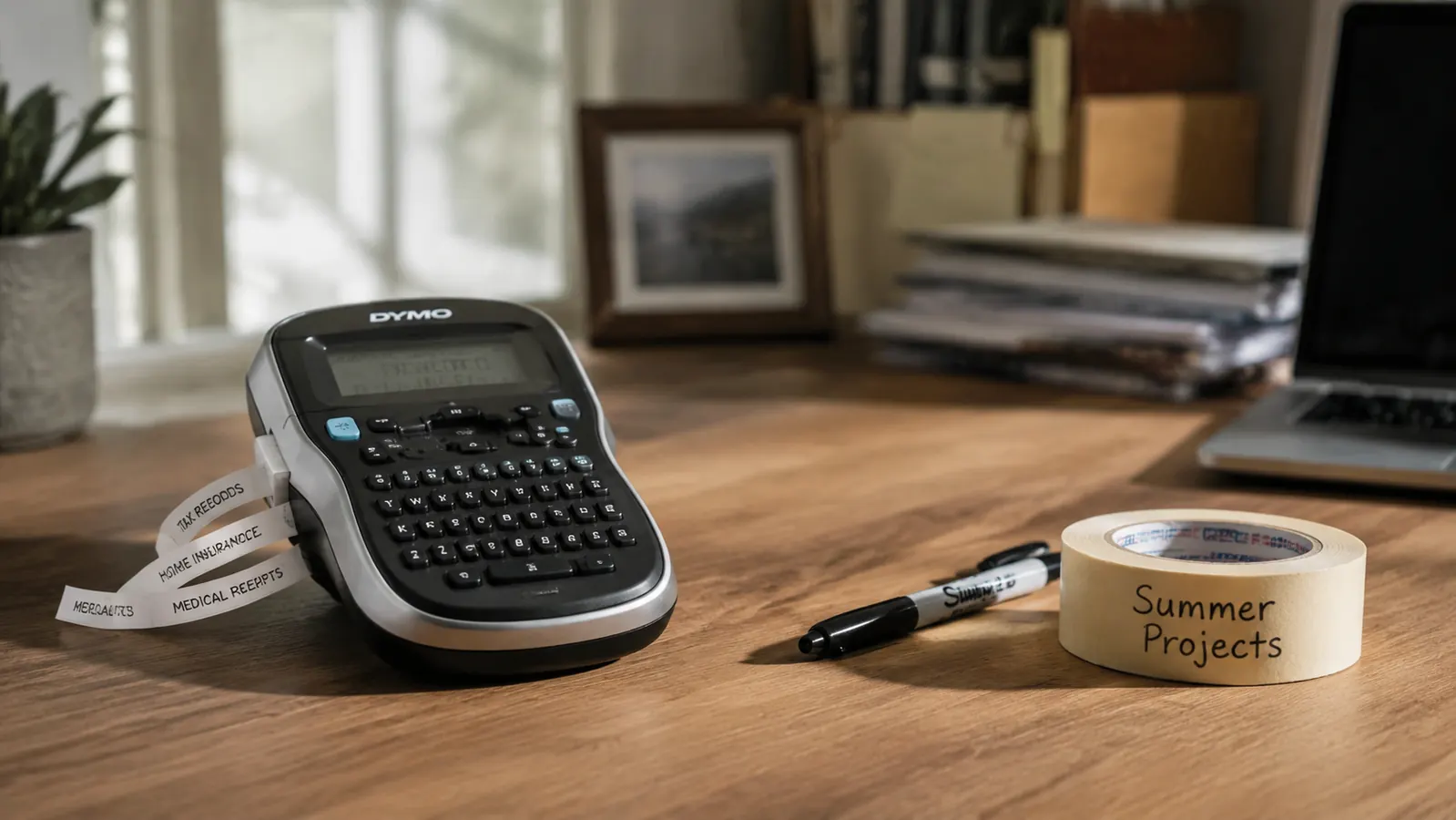
If you only need one answer, here it is: a label maker wins for anything you'll look at more than a few times, and handwritten labels are fine for anything you'll toss out by next week. That's really the whole decision. I spent about six weeks going back and forth between my old system, a fat black marker and a roll of masking tape, and a small handheld DYMO label maker my daughter talked me into buying for my home office. I wasn't convinced I needed it. I'd been labeling file folders and storage bins by hand for years and it always felt like a fine enough system, right up until I actually compared the two side by side.
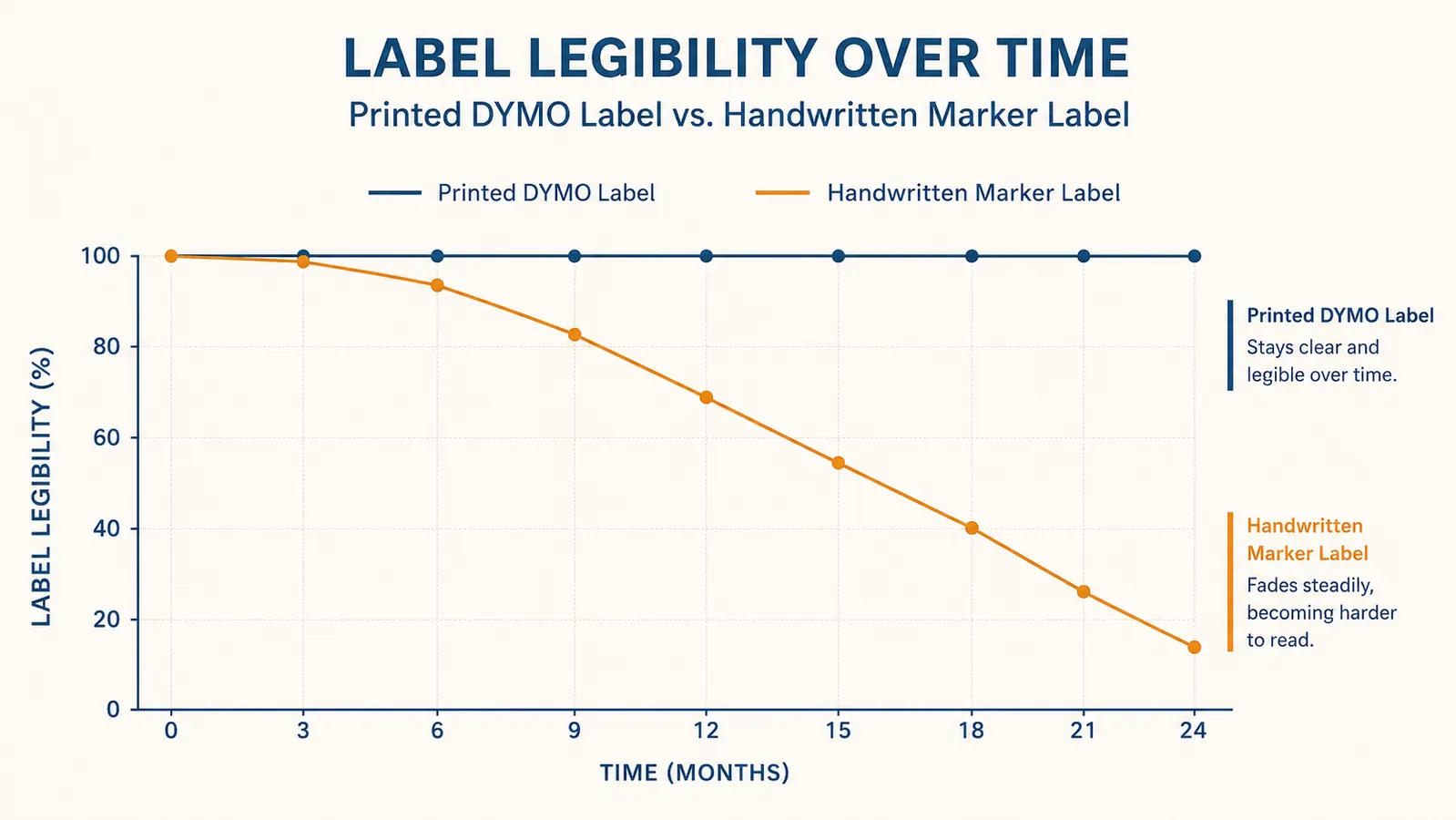
Here's what changed my mind. It wasn't speed, and it wasn't even really about looking neater, though that helped. It was that six months from now, I can still read every single label the DYMO printed, and I can't say the same about half the ones I wrote by hand in a hurry between phone calls. That's the gap this comparison is really about.
To be fair about this, I didn't just glance at both and guess. I relabeled my entire home office over two separate weekends, once with the marker and tape I'd used for years, and once with the DYMO LetraTag label maker, then left both sets alone and checked back on them weekly for six weeks. I labeled file folders, storage bins on my closet shelving, a shoebox of old cables, spice jars I keep near my desk for tea, and even a couple of power strips under the desk that always seem to grow a nest of identical black cords. That gave me a fair, apples-to-apples look at how each one actually holds up once the novelty wears off and real daily use sets in.
| What Matters | DYMO Label Maker | Handwritten Labels |
|---|---|---|
| Upfront Cost | One-time cost is under $50 and the tape cartridges last a long while | Already own a marker and a roll of masking tape, so the cost feels like nothing |
| Legibility | Every label comes out in crisp, even print, easy to read from across the room | Legibility depends entirely on your handwriting that day, and mine gets worse when I'm rushed |
| Speed Per Label | Takes about 10 to 15 seconds per label once you're used to the keyboard | Faster for a single quick label, no typing or button pressing needed |
| Durability | Adhesive tape holds up for years without curling, peeling, or fading in sunlight | Marker ink fades within months and masking tape edges start curling and lifting |
| Consistency | Font size and style stay identical from the first label to the five hundredth | Handwriting style drifts depending on how tired you are or how fast you're moving |
| Power Source | Runs on AA batteries, no cord needed, though batteries eventually need swapping | Needs nothing but a marker that already has ink, no batteries to ever think about |
| Fixing Mistakes | A typo means retyping and reprinting a clean new label in seconds, no mess left behind | A mistake usually means a crossed-out word or a fresh scrap of tape to cover it |
| Best Use | Best for anything long-term: file folders, storage bins, cords, pantry jars, cables | Best for a one-time note or something you plan to toss out within a week or two |
| Learning Curve | Small learning curve the first day, figuring out the buttons and tape cartridges | Zero learning curve, everyone already knows how to write with a marker |
Where the DYMO Label Maker Wins
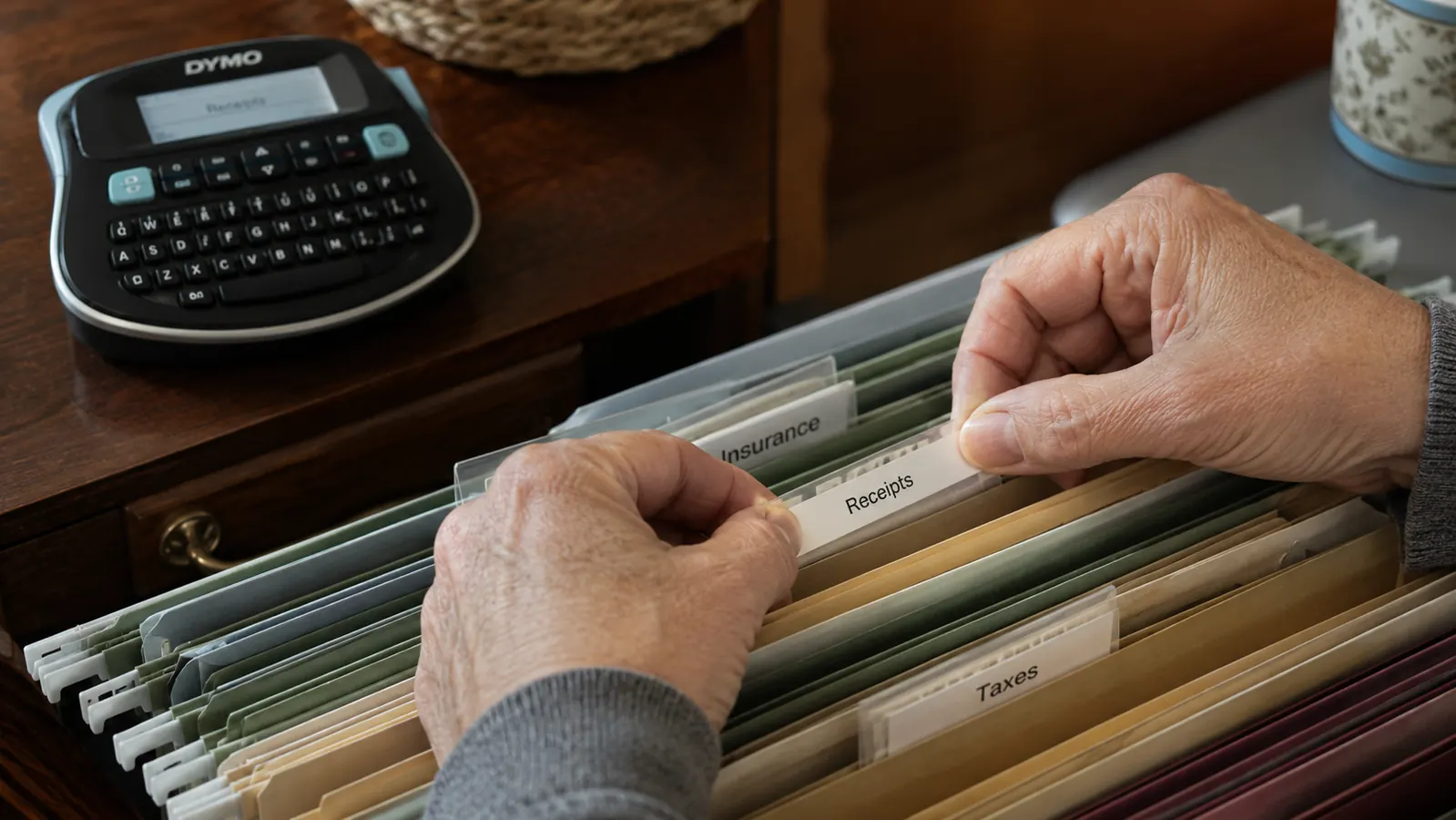
The DYMO label maker wins the moment a label needs to survive longer than a few weeks. I relabeled every hanging file folder in my home office filing cabinet over one weekend, about 40 folders in total, and every single one still looks exactly like it did the day I printed it. Compare that to the folders I'd labeled by hand two years earlier, where half the ink had faded to a gray smudge and a few labels had curled up at the corners so badly I had to press them back down before I could even read them. The DYMO tape is a real adhesive-backed strip that seals the printed text under a clear laminate layer, so it doesn't matter if a folder gets pulled out and pushed back in a hundred times, the label doesn't rub off or smear.
It also wins on consistency, which I didn't expect to care about but genuinely do now. When I hand letter a stack of labels, especially late in the day, my writing gets smaller and sloppier by the twentieth one. The DYMO doesn't get tired. Every label out of it is the same clean font, the same size, lined up the same way every time. That matters more than it sounds like it should when you're labeling client folders, tax document boxes, or anything you'll be searching for quickly under pressure. I keep my DYMO in the top drawer of my desk and reach for it now almost automatically whenever I set up a new folder or bin, the same way I'd reach for a stapler.
There's also a practical side to this that surprised me. My eyesight isn't what it used to be, and neither is my handwriting once my hand gets tired toward the end of a long afternoon of paperwork. The DYMO's buttons are large enough that I don't have to squint to find the right letter, and the little screen shows me exactly what I've typed before it prints, so there's no guessing whether a label came out crooked or smudged. For anyone whose handwriting has gotten shakier with age, or who just doesn't trust their own printing to stay neat past the first few words, that built-in quality control is worth more than it sounds like on paper.
The other thing I underestimated was how the cost works out once you actually add it up. A single cartridge of DYMO label tape prints dozens and dozens of labels, so once you get past the initial purchase, each individual label costs a few cents at most. I've relabeled close to two hundred items across my office and closets since I started using mine, and I'm still on the same cartridge it came with. Compare that to how many rolls of masking tape and how many markers I've gone through over the same stretch of years, replacing a dried-out marker every so often and buying fresh tape when the old roll got too gummy to peel cleanly. It's not a dramatic savings, but it adds up quietly in the same way most good, boring purchases do.
Where Handwritten Labels Win
Handwritten labels still win for anything quick and disposable. If I need to mark a single box "donate" before it goes in the car this afternoon, or scribble a reminder note on a sticky pad for myself, grabbing the label maker would be silly. There's no cartridge to check, no buttons to press, no waiting for the tape to feed through. A marker and a scrap of tape wins on pure speed for a single, temporary label you'll peel off within a day or two anyway.
It also wins when you're labeling something oddly shaped or need to write more than a short line or two of information. The DYMO's small display and narrow tape width aren't built for long sentences or anything beyond a short phrase. If I need to jot down three sentences of instructions for whoever waters my office plants while I'm traveling, a sticky note and a pen is still the faster, more practical tool. And if you genuinely only label things once in a blue moon, a marker sitting in your junk drawer already does the job well enough that buying a dedicated device might be overkill.
A marker also wins on awkward surfaces. I have a couple of curved glass jars near my desk where I keep tea bags and paper clips, and the DYMO's flat adhesive tape doesn't wrap around a curved edge nearly as cleanly as a few words written straight onto painter's tape and pressed on by hand. For anything textured, curved, or damp, a marker adjusts to the surface in a way a printed strip sometimes fights against.
And I'll say this plainly, because I think it matters for anyone reading this who feels the same way I did at first: if the idea of learning to use one more small gadget just sounds tiring, a marker will never ask anything of you. There's real comfort in a tool that hasn't changed since grade school. I understand the appeal of sticking with what you know, especially if you've had bad experiences with gadgets that promised to make life easier and just added another thing to charge, program, or troubleshoot. The DYMO label maker isn't that. It's about as simple as a device gets, but I want to be honest that the marker's simplicity is real too, not just old habit.
Tired of squinting at faded marker labels from two years ago? Print it once, read it for years.
If your file folders, storage bins, and cords are labeled with anything that has to be re-written every year, the DYMO label maker fixes that permanently. It's a small, one-time addition to a home office that pays for itself the first time you're not searching blind through unmarked bins.
Amazon Check Today's Price on Amazon →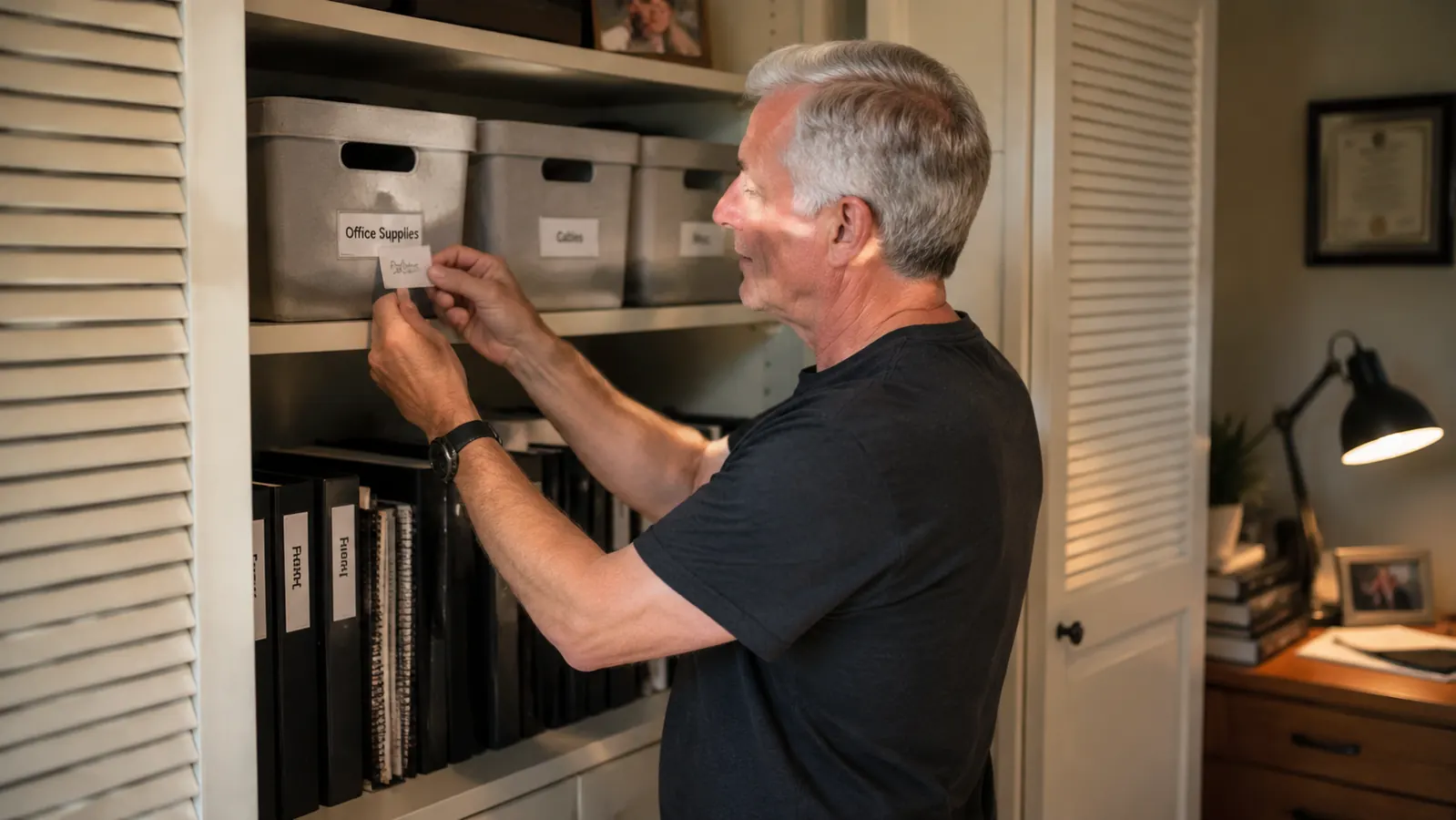
Who Should Buy Which
If you're setting up a home office for the long haul, meaning file folders you'll keep for years, storage bins that get reused season after season, or cords and cables you're tired of untangling to find the right one, buy the DYMO label maker and don't look back. I wish I'd bought mine years earlier instead of re-writing the same faded labels every spring cleaning. It's the kind of small purchase that stops feeling like a purchase within about a week, because you stop noticing it and just start using it, the same way you'd stop noticing a good pair of scissors sitting in the same drawer.
I'll admit I'm careful about recommending anything online, since I've been burned before by products that looked good in photos and fell apart within a month. What made me comfortable with this one is that it's a name I already recognized from office supply stores growing up, and the reviews backing it up are not small numbers, tens of thousands of people rating it, most of them landing at the same conclusion I did after using it myself. That's not a guarantee nothing ever goes wrong, but it's a reasonable amount of real-world evidence before you spend your own money on it.
If your labeling needs are mostly one-off, a box going to the donation pile, a temporary note for a family member, or something you'll toss within days, keep the marker and masking tape in the drawer where it belongs. Some of us end up using both. My DYMO handles anything permanent in the office, and a plain marker still lives in my kitchen junk drawer for the quick stuff. Neither one is wrong. The question is just how long you need that label to last, and how many times you're willing to rewrite it before you finally decide it's worth doing once, properly, with the DYMO.
Still relabeling the same bins every year? Do it once with the DYMO.
A crisp, adhesive-backed label from the DYMO label maker holds up for years, not months. If you're done with faded marker and curling masking tape, this is the small upgrade that quietly keeps your whole home office easier to find your way around.
Amazon Check Today's Price on Amazon →